fr en
Menu Close
MOTION MOTION TRAILER A year In review CELEBRATE WITH CARTIER
Works
We are composers We are sound designers We are a music creative team
About
What is sound design ? Multi-channel sound design for Tudor Sound design boosted with immersive audio News
hello@mooders.net
Nantes, Rennes, Paris
Twitter ,  Linkedin ,  Instagram
Contact
2 5 8 1

Immersive sound and scenography

INTRODUCTION

In scenography, images and lighting immediately catch the eye. However, it is often immersive sound that gives depth to a space and transforms an installation into a true experience.

Thought out from the design stage, it reinforces storytelling, guides audiences, and creates an atmosphere consistent with the brand’s universe.
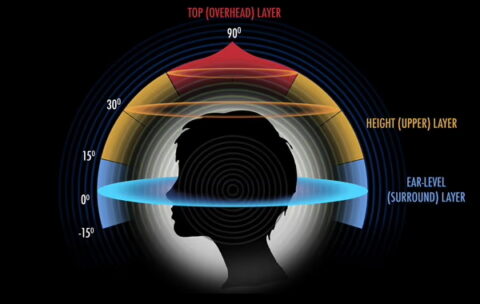
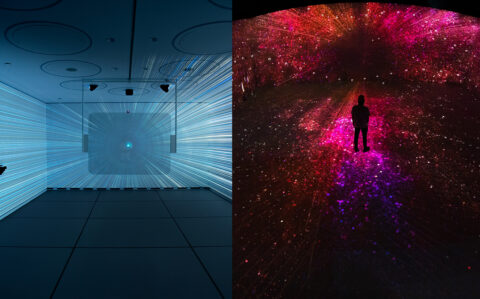
What exactly is immersive sound ?


We talk about immersive sound when the sound:

occupies three-dimensional space,

moves around the visitor,

changes depending on the area in which it is located,

interacts with light, images, and sometimes with the audience’s movements.

Unlike a conventional stereo soundtrack, immersive sound relies on differentiated sound spaces (zones, atmospheres, focus), coexisting sound layers (music, sound design, voices, interactive elements), and movements (trajectories, rotations, approaches, departures) designed in conjunction with the scenography.

Technically, this can take the form of:

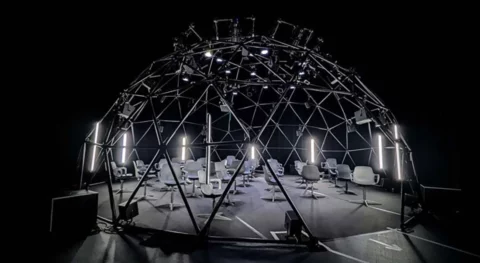
a multichannel system (5.1, 7.1, 16 channels and more), spatialized diffusion in a dome, cube, or 360° space, binaural content via headphones for individual journeys, or ambisonic formats for specific installations.

The goal is not to “put speakers everywhere,” but to design a sound experience that makes sense with the space and the narrative.

How does immersive sound enhance the impact of stage design ?


Amplify storytelling

Immersive sound extends creative intentions: it can give a place a sensory signature, accentuate a narrative, or set a mood. The same scenography can appear contemplative or intense simply through the choice of sound textures or dynamics.

Guiding and directing audiences

Sound is a discreet but powerful tool for directing traffic. It can draw people to an area, accompany a transition, or mark a key moment. This allows traffic flows to be managed without visual overload, simply through well-placed sound cues.

Smooth transitions

Scene changes, resets, or lighting variations can be abrupt. Immersive sound helps smooth these transitions, accept a break, or maintain attention. It ensures continuity that avoids perceptual “gaps.”

Create listening comfort

A well-designed system adjusts levels, preserves intelligibility, and prevents auditory fatigue. Immersive sound is not “loud all the time”: it breathes with the space and accompanies visitors without overwhelming them.

From composition to distribution : the key stages of an immersive sound project


Step 1 – Venue and Project Analysis

Before any music is written, we begin by listening and observing:

the venue: volumes, materials, reverberation, ambient noise, sensitive areas,

the project: brand objectives, message to convey, desired emotion,

the flow: capacity, time spent there, audience circulation, type of mediation.

This phase allows us to define a sound specification:

what role should immersive sound play here, very concretely?


Step 2 – Design: Sound Storytelling & Sound Spaces

The design phase then begins:

defining the sound narrative (chapters, climaxes, quiet zones),

dividing it into sound spaces: what atmospheres for which zones,

integrating it with the scenography, lighting, and video,

choosing the formats (multichannel, binaural, ambisonic, etc.) and the appropriate sound system.

We develop audio implementation plans: speaker placement, coverage areas, routing, and control room requirements.

This step is crucial for aligning creative objectives with logistical constraints.


Step 3 – Immersive Composition and Sound Design

Based on this, we can begin the creative process:

original musical composition aligned with the brand identity,

sound design (textures, atmospheres, specific elements, signatures),

preparation of versions adapted to different spaces (lobby, main hall, pre-show, post-show, etc.),

integration of voices or messages if necessary (languages, levels, intelligibility).

The work is designed from the outset for an immersive mix, not for a simple stereo transposition to multiple speakers.


Step 4 – Spatialization and Pre-Mixing

Next, the technical and creative team works on the spatial dimension:

virtual placement of sound sources in the space,

trajectories (sound moving across the room, a voice rotating, a texture rising),

management of sound planes (front/back, top/bottom, peripheral),

balancing between voices (music, sound design, effects).

This work is done in the studio with dedicated spatialization tools, simulating the final system as closely as possible.


Step 5 – Multichannel Distribution and On-Site Calibration

On-site integration is the crucial moment:

installation and testing of the multichannel system (position, angles, delays, levels),

calibration to account for the actual acoustics of the venue,

adjustments to the content (EQ, dynamics, spatialization),

synchronization with lighting, video, and any sensors or interactive systems.

This is also where the robustness of the whole system is validated: safety margins, operating procedures, redundancy management.

Why integrate immersive sound early in a project?

When considered from the outset, sound becomes a true pillar of scenography:

it reinforces overall coherence,

clarifies the visitor’s journey,

enriches the experience without visual overload,

ensures production by avoiding last-minute adjustments.

It’s no longer simply about “adding sound,” but about working with a spatial material that interacts with all the other components of the project.


Conclusion

Immersive sound is not a mere technical addition: it’s a form of expression that structures the experience.

By integrating it from the design stage, creative directors, scenographers, and producers can give their installations a clarity, emotional impact, and coherence that are difficult to achieve otherwise.

It then becomes a true narrative vehicle—discreet, powerful, and essential.

Next Article
Sound Designer and Portfolio
Making immersive sound a strategic lever to enhance the impact of immersive experiences
Categories
Skills
TOPICS
IMMERSIVE SOUND
SOUND SPATIALIZATION
IMMERSIVE EXPERIENCE
Back to
News
In the same category
Sound Design and Brand Experience : The Power of Sound in Immersive Experiences Sound design boosted with immersive audio Audio branding, Sound production, Sound design and more…
Contact us
hello@mooders.net
+33 5 00 00 00 00
Twitter , 
Linkedin , 
Instagram